 Emre Ceylan
What is ROI in machine vision is a question that shows up as soon as a camera is wired into a line. ROI means region of interest: a rectangle or mask the system measures instead of the full frame. Fewer pixels, shorter cycle, less background noise.
Lighting is covered in industrial camera lighting selection; trigger in conveyor camera triggering and encoder.
What is ROI in machine vision?
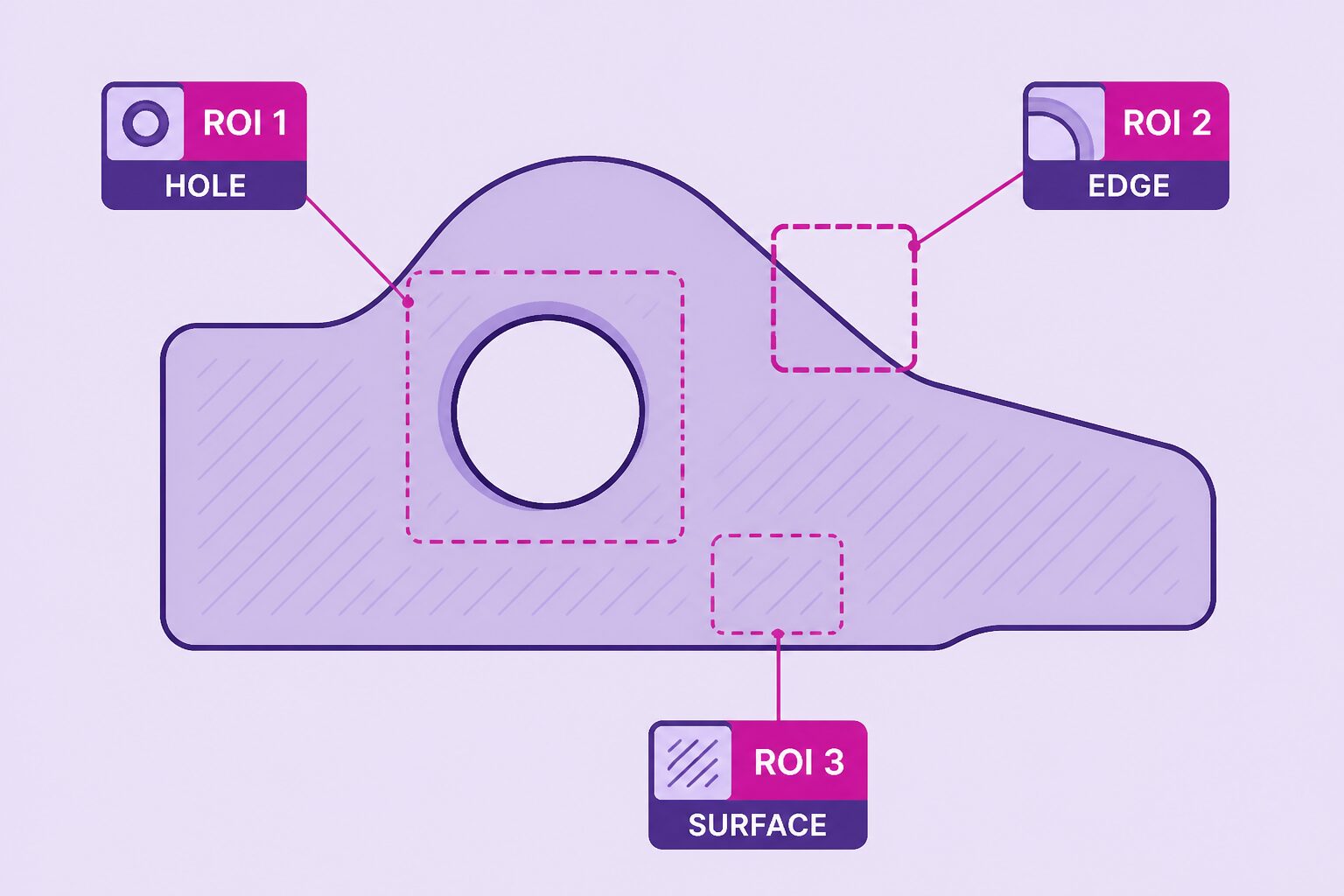
ROI cuts the data that reaches the processor. A 5-megapixel sensor may still only need a 400×300 window on the part. The same hardware can then run a faster line or a tighter threshold. The second gain is false alarms: belt edges, neighbouring lights, or an operator’s hand can look like defects in a full-frame algorithm. The window locks the measurement to the part geometry.
Layers are outlined in what is machine vision. The board sits under machine vision.
Why it matters
- Fewer pixels: shorter cycle and lower bandwidth
- Background cut: fewer false alarms
- Privacy: faces or label text can stay out of the saved frame
- Multiple windows: screw, label and edge with separate thresholds
How it works
On a fixed station where the part always stops in the same window, ROI is almost mandatory. On a conveyor with encoder triggering, the window is locked to belt coordinates: the part may drift, the trigger moves, the ROI does not. Variable sizes need a coarse locate plus a tight ROI, or several windows.
If the sensor supports it, a narrow ROI raises frame rate. Cropping later on the host does not give the same gain. The industrial camera interface (USB/GigE) should apply the window before capture.
Typical uses
- Screw / clip present-absent
- Label edge and code window
- Hole and gasket silhouette
- Fill meniscus
- Privacy-constrained recording
Common mistakes
Shrinking ROI “as small as possible” is a risk. Part tolerance, vibration and lens distortion clip the edge. Leave margin beyond expected scatter. When lighting changes, contrast shifts; the same ROI with the same threshold fails. Without an encoder on a moving belt the window sees empty belt or a half part.
Outer frame: Wikipedia — machine vision.
Design checklist
- Does the window leave margin beyond part tolerance?
- Is trigger locked to the encoder?
- Were light and threshold calibrated together?
- Separate thresholds for multiple ROIs?
- Save full frame or window only?
FAQ
Is ROI the same as crop?
Close. Crop is usually a cut for recording or display. ROI on many cameras is a window before capture or processing; bandwidth and frame rate can change with it.
Can one scene have several ROIs?
Yes. Separate windows for a screw, a label and an edge. Each window should keep its own threshold and delay.
Does a smaller ROI increase frame rate?
If the sensor and interface support it, yes. USB and GigE cameras often deliver higher fps with a narrow ROI. Host crop does not.
Is ROI enough on a moving belt without an encoder?
No. ROI is fixed in space. If the part slides, trigger time must be locked as well.
Results
What is ROI in machine vision? The window the camera actually decides on — not the whole scene. Speed, false alarms and privacy all pass through that window.
🔗 Get in touch with us:
Phone/WhatsApp: +41 76 212 8248
📧 E-Mail: info@revantechnology.ch
For detailed information about our services in electronics development & PCB design:
Revan Technology – Your partner for professional electronics and PCB development