 Veysi Filiz
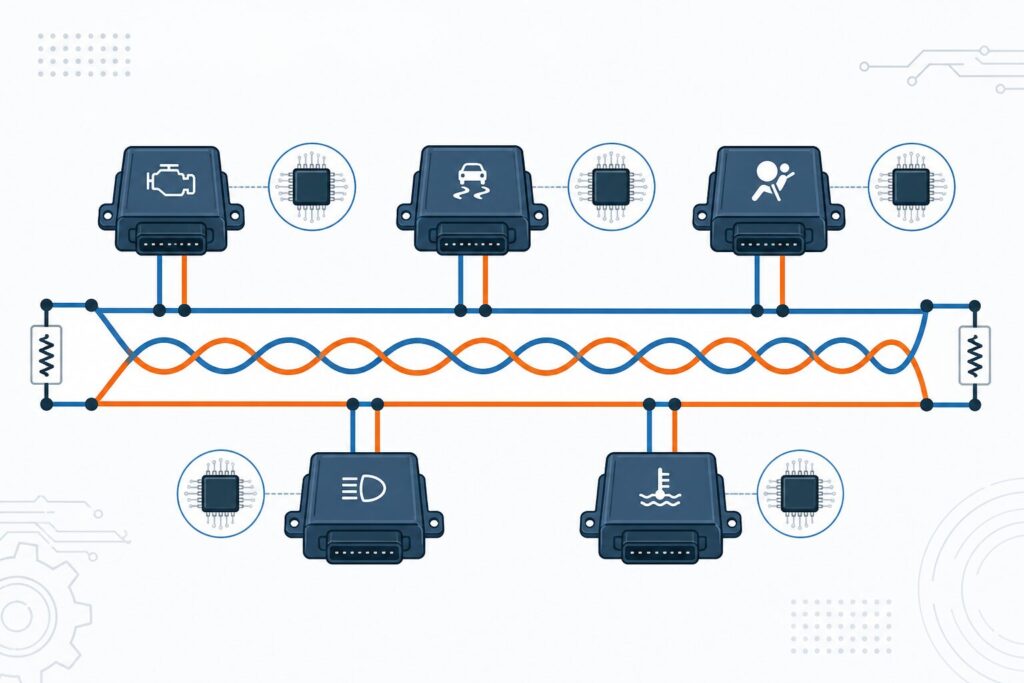
What is CAN bus? In short, Controller Area Network is a serial communication protocol that lets multiple electronic nodes share data on a single differential pair with built-in collision resolution and fault tolerance. It is widely used in automotive, machine automation and embedded control boards so sensors, actuators and ECUs can communicate reliably on one network.
In Revan Technology’s industrial projects, CAN bus often provides a more predictable field infrastructure than RS-485 or SPI over long cable runs and in noisy environments.
What is CAN bus?
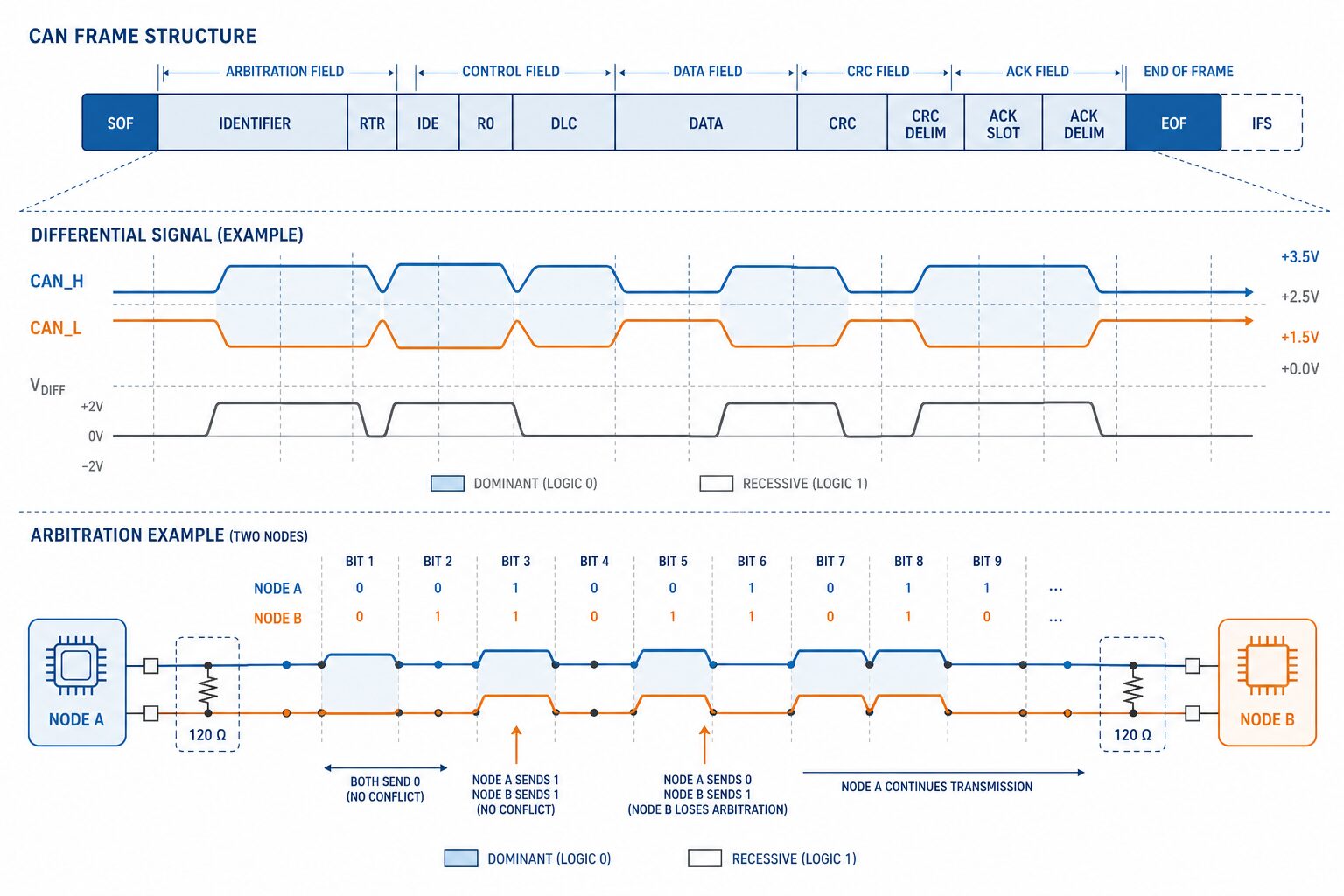
CAN bus (Controller Area Network) is a serial data bus protocol originally developed for automotive applications. It does not require a single master: each node broadcasts messages identified by an ID, and receivers filter the frames they need. The physical layer typically uses a differential CAN_H / CAN_L line.
ISO 11898 and CAN 2.0A/B (standard and extended frame) are the most common variants. CAN FD offers higher data rates and larger payloads in modern designs.
Why does it matter?
- Dozens of nodes on one bus — lower wiring complexity and cost.
- Collision resolution via hardware arbitration; no central master required.
- Error detection, retransmission and bus-off protection improve field reliability.
- De facto standard in automotive, agricultural machinery, elevators, energy and factory automation.
How does it work?
1. Nodes connect to the shared bus through CAN transceivers; termination resistors (typically 120 Ω) are placed at the bus ends.
2. An idle bus is recessive (logical 1); a dominant (0) bit wins arbitration.
3. Lower-ID messages win arbitration; losing nodes back off and retry.
4. Receivers filter by ID; CRC and ACK verify frame integrity.
5. Nodes exceeding error thresholds enter bus-off; the rest of the network can continue.
Bit rate is inversely related to cable length: 1 Mbit/s for short runs, 125 kbit/s typical for long industrial buses.
Typical use cases
- Automotive ECU networks (engine, ABS, instrument cluster)
- Drive–PLC communication on CNC, robot and packaging machines
- Joystick and hydraulic control units on agricultural and construction equipment
- Elevator and building automation control panels
- Battery management systems (BMS) and energy storage modules
Common mistakes
- Missing or misplaced termination — reflections and corrupt frames.
- Weak ground reference — common-mode noise on the differential signal.
- Bit rate not matched to cable length.
- Mixing CAN and CAN FD nodes on the same bus.
- No plan for recovery and logging after bus-off events.
Selection / design checklist
- Standard CAN or CAN FD?
- Bit rate suited to bus length and node count?
- 120 Ω termination at both ends (or calculated equivalent)?
- Transceiver I/O level (3.3 V / 5 V) compatible with the MCU?
- Galvanic isolation required (e.g. field panel)?
- ID plan, periodic messages and diagnostics (UDS / J1939) defined?
FAQ
What is CAN bus in one sentence?
A serial protocol where multiple electronic units exchange ID-based messages on one differential line.
How does CAN bus differ from Modbus RTU?
Modbus is usually master–slave; CAN uses multi-cast style messaging and hardware priority arbitration. CAN also offers stronger error handling and an automotive/industrial ecosystem.
Why is a termination resistor needed?
It reduces signal reflections at high frequency and lowers frame errors; 120 Ω at both ends is standard on most buses.
When should CAN FD be used?
When larger payloads (up to 64 bytes) and higher bit rates are needed — all nodes must support CAN FD.
Conclusion
CAN bus is a proven, scalable communication backbone for industrial and automotive embedded systems. With correct termination, bit rate and ID planning, field data loss and downtime drop significantly. If you are designing a new control board or machine network, choosing CAN bus early against your requirements avoids costly protocol changes later.
🔗 Get in touch with us:
Phone/WhatsApp: +41 76 212 8248
📧 E-Mail: info@revantechnology.ch
For detailed information about our services in electronics development & PCB design:
Revan Technology – Your partner for professional electronics and PCB development