 Emre Ceylan
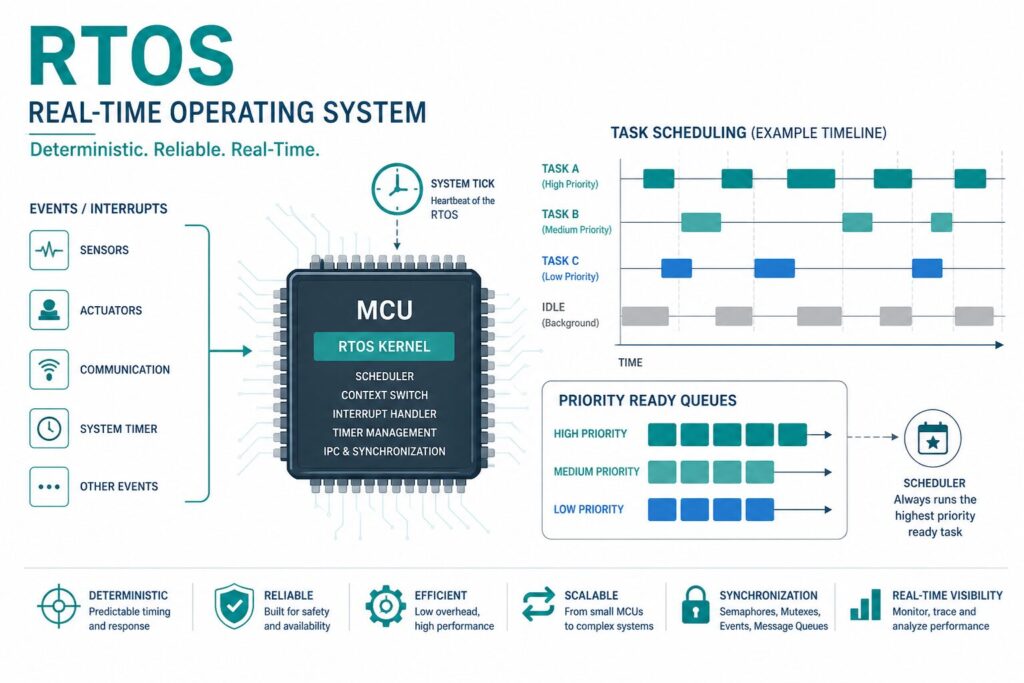
What is an RTOS? In short, a real-time operating system (RTOS) is a lightweight OS kernel that manages multiple software tasks on an embedded device using priority, scheduling and resource-sharing rules. It ensures parallel work such as sensor reading, communication, motor control and alarm logic runs within predictable time frames.
In Revan Technology projects, an RTOS offers a more predictable and maintainable architecture than a bare-metal loop for complex field devices.
What is an RTOS?
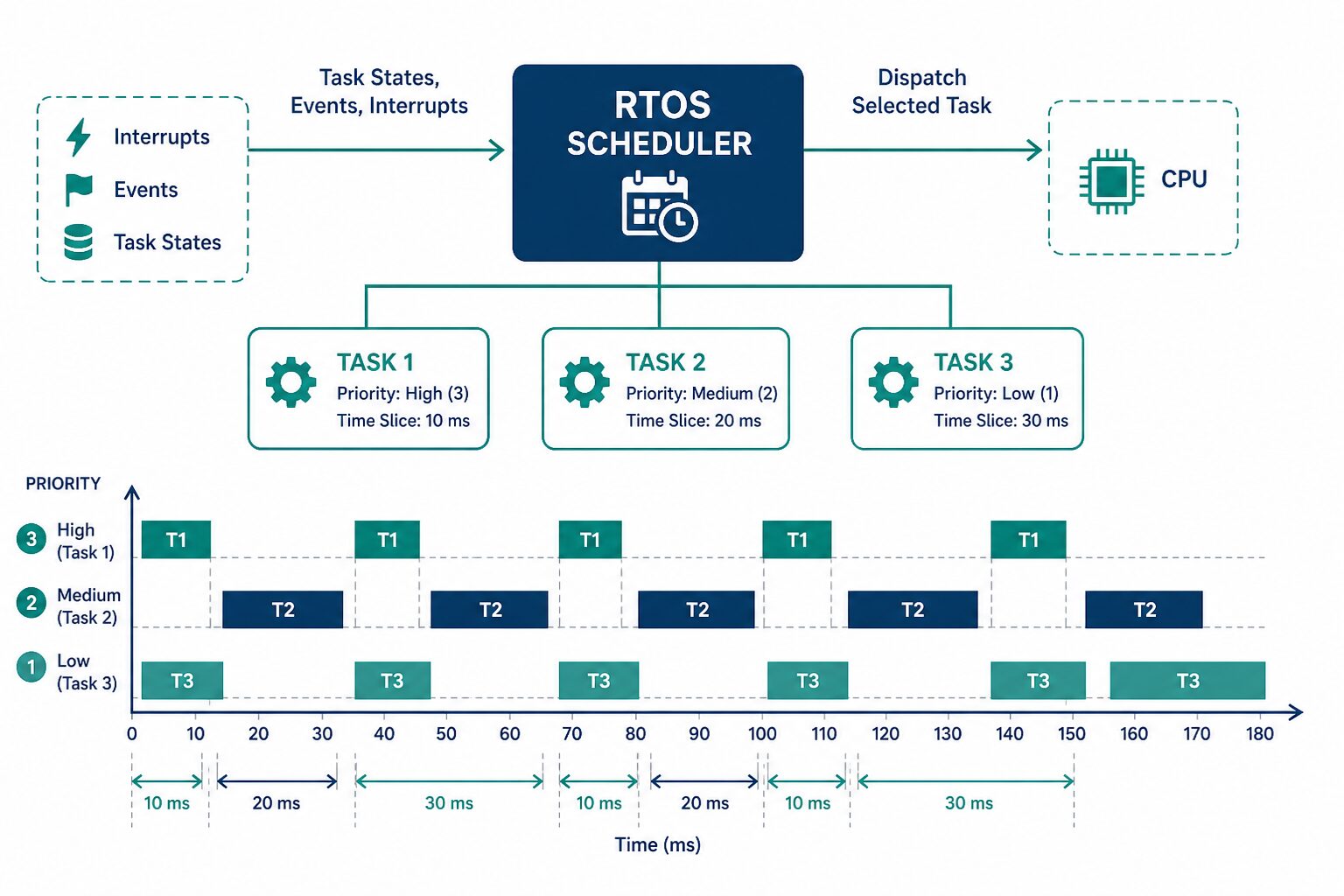
An RTOS (Real-Time Operating System) is an embedded software layer that creates, schedules and prioritises tasks. “Real-time” does not mean every job finishes instantly; it means critical events are handled within defined time limits. Popular kernels such as FreeRTOS, Zephyr and ThreadX are widely used on industrial MCUs.
An RTOS safely manages shared resources through synchronisation tools such as mutexes, semaphores, queues and timers.
Why does it matter?
- It lets communication, measurement and control tasks run on the same MCU without conflict.
- Priority for critical alarm or safety functions makes response time predictable.
- Code modularity improves; adding features is more controlled than in a single super-loop.
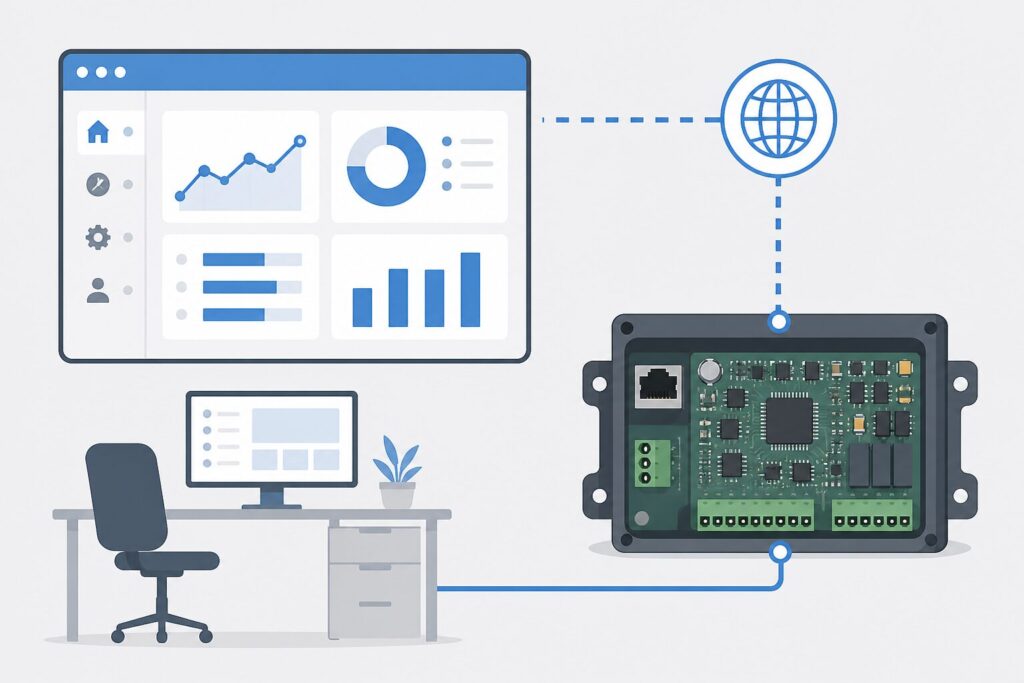
- Background work such as OTA updates, logging and remote monitoring does not block main control.
How does it work?
1. The application is split into independent tasks (e.g. sensor reading, Modbus, UI).
2. The RTOS kernel assigns priorities and runs the highest-priority ready task.
3. When a task waits (data, time, event), the CPU switches to another task — a context switch.
4. Timers and interrupts are used for periodic sampling and deadline tracking.
5. Shared data is protected with mutexes or queues; deadlock risk is managed in design.
A preemptive RTOS can interrupt a lower-priority task immediately to run a higher-priority one; a cooperative RTOS waits for a task to voluntarily yield the CPU.
Typical use cases
- Industrial IoT gateways and field data acquisition devices
- Motor drives and multi-axis control boards
- Embedded interface units with HMI panels
- Remote monitoring nodes with GSM / LoRa communication
- Long-life devices requiring OTA and security updates
Common mistakes
- Choosing RTOS for every problem; unnecessary complexity on simple single-task devices.
- Assigning priorities without a plan; critical tasks get delayed.
- Using shared variables across tasks without protection; race conditions occur.
- Guessing stack sizes without measurement; silent stack overflow.
- Making blocking RTOS calls inside interrupts; the system locks up.
Selection / design checklist
- Are the number of parallel tasks and typical deadline requirements clear?
- Is a preemptive or cooperative RTOS more appropriate?
- Is memory (RAM/flash) budget sufficient for RTOS plus task stacks?
- Are communication and hardware drivers suited to the task model?
- Are watchdog feeding and error recovery policies defined?
- Was debug (trace, assert, stack watermark) tested before production?
FAQ
What is an RTOS in one sentence?
A lightweight OS kernel that manages multiple tasks on an embedded device using priority and scheduling.
Bare-metal or RTOS?
If a single simple tight loop is enough, bare-metal is lighter; when communication + control + background work run together, RTOS is advantageous.
Is FreeRTOS enough for industrial projects?
For many MCU projects, yes; licence, ecosystem and driver support are broad. Alternatives are evaluated for very low power or strict certification requirements.
How is RTOS performance measured?
Task response time, context switch time, CPU utilisation and stack watermark are monitored; stress testing is done before field deployment.
Conclusion
An RTOS is a practical way to organise tasks predictably in complex embedded systems. With correct prioritisation, resource protection and stack planning, both development speed and field reliability improve on industrial devices. Evaluating task architecture from an RTOS perspective at the start of a new control board design reduces later architectural rework.
🔗 Get in touch with us:
Phone/WhatsApp: +41 76 212 8248
📧 E-Mail: info@revantechnology.ch
For detailed information about our services in electronics development & PCB design:
Revan Technology – Your partner for professional electronics and PCB development