 Veysi Filiz
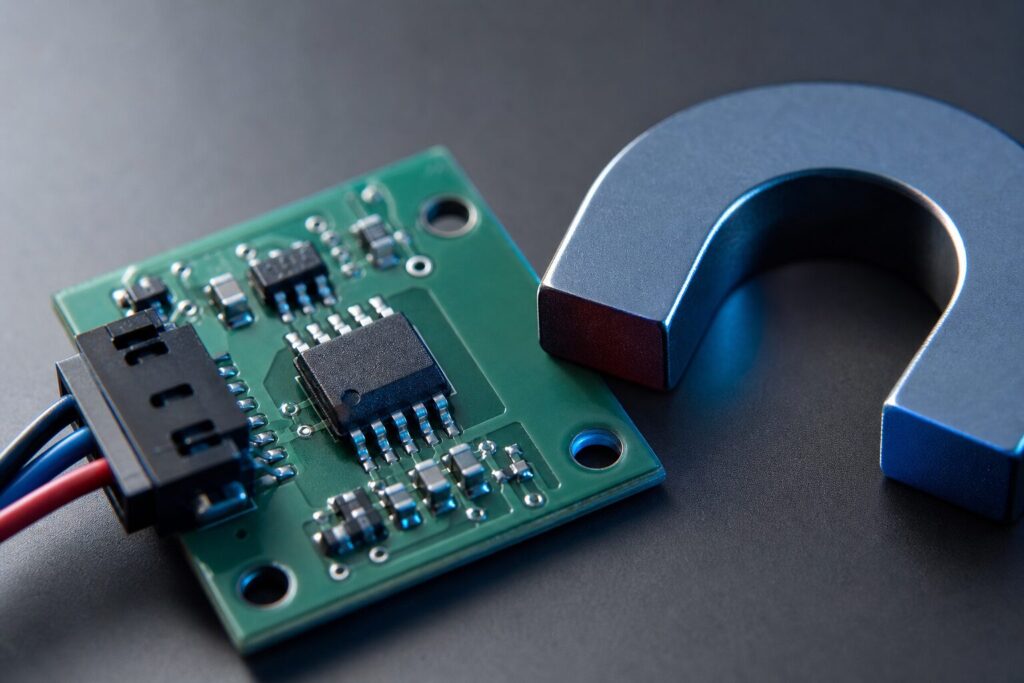
What is a Hall effect sensor? In short, it is a semiconductor-based sensing element that converts changes in magnetic field strength into a voltage difference, used for contactless position, speed and current detection. It is widely chosen in industrial automation and embedded boards for critical tasks such as door position, motor speed and current measurement.
In Revan Technology's motor control and field panel projects, Hall sensors provide a longer-lasting, dust- and moisture-resistant sensing layer compared to mechanical switches.
What is a Hall effect sensor?
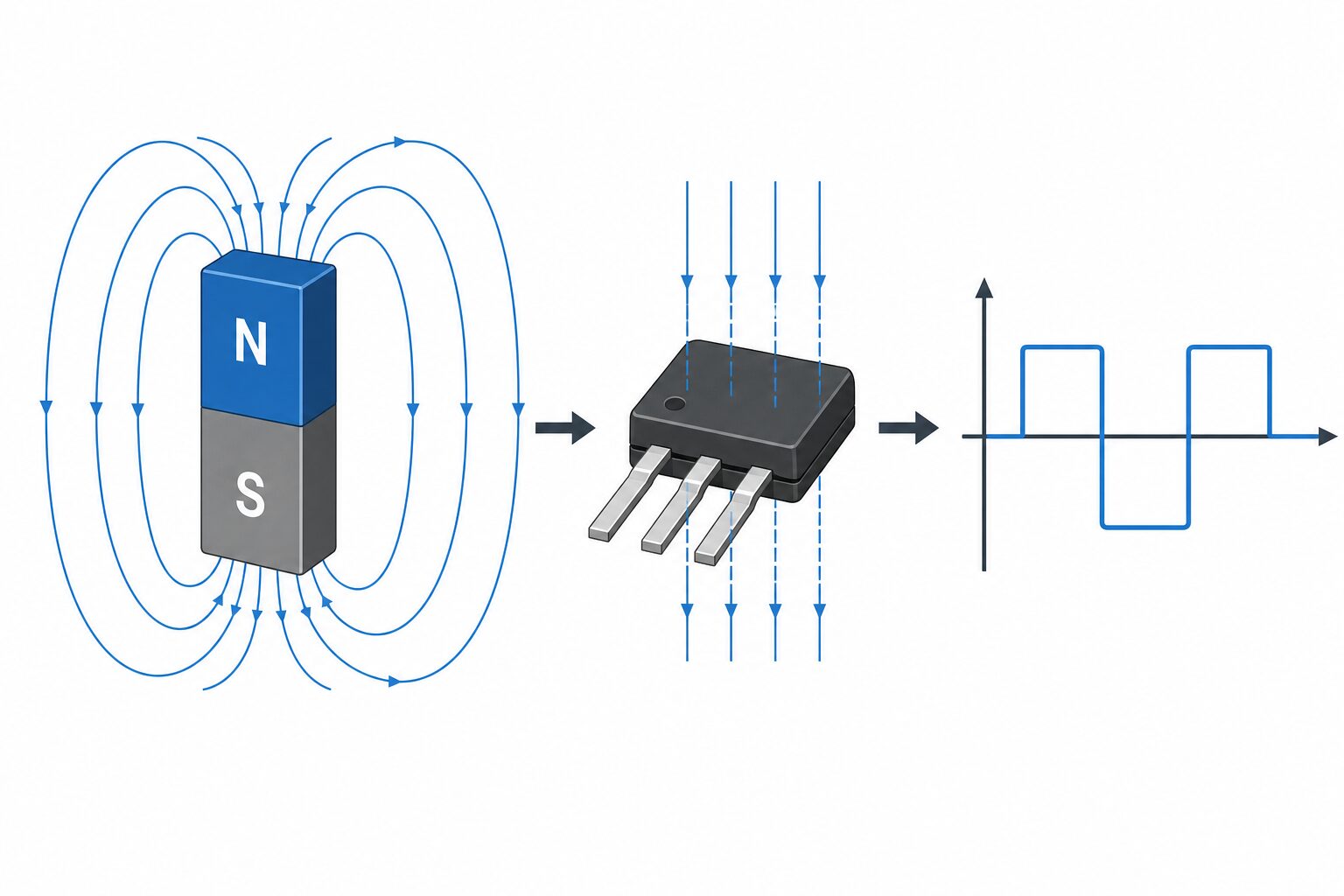
A Hall effect sensor detects a magnetic field by measuring the Hall voltage generated across a current-carrying conductor or semiconductor. As magnetic field strength increases, the output signal changes; this allows detection of magnet position, rotor angle or current magnitude.
Digital (on/off) and analog (proportional voltage) output types are available. Integrated Hall ICs typically combine threshold comparators, temperature compensation and protection circuits in a single package.
Why does it matter?
- Contactless sensing reduces wear and failures caused by mechanical friction.
- It operates more reliably than reed switches in dusty, oily and humid environments.
- It is a standard solution for rotor position and speed feedback in motor drives.
- It offers a compact, isolated alternative for current measurement.
How does it work?
1. A permanent magnet or current-carrying conductor creates a magnetic field.
2. The Hall element is exposed to the perpendicular component of this field and generates a Hall voltage.
3. The integrated circuit amplifies the signal and applies thresholds or linear scaling.
4. A digital output provides a logic level; an analog output provides a proportional voltage.
Magnetic field direction and the mounting angle of the sensor package directly affect output behaviour; mechanical placement is therefore part of the design.
Typical application areas
- Rotor position detection in BLDC and servo motors
- Industrial door, piston and valve position switches
- Current sensors (Hall-based) and power measurement boards
- Encoders with gear or magnet disc for speed measurement
- Safety interlocks and two-hand control systems
Common mistakes
- Leaving magnet poles and mounting distance outside datasheet limits.
- Placing the sensor too close to strong external magnetic sources (motor coil, transformer).
- Using a digital Hall output on long cables without filtering; noise and false triggering occur.
- Ignoring reference voltage and ADC resolution for analog Hall outputs.
- Overlooking temperature drift in high-precision applications.
Selection / design checklist
- Is a digital or analog output required?
- Are operating temperature and magnetic threshold (Gauss) range suitable?
- Are magnet type, distance and alignment tolerances defined?
- Is the output type (open-drain, push-pull) compatible with the MCU/PLC input?
- Is filtering or a Schmitt input planned for EMI and cable length?
- Are isolation and linearity requirements met for current measurement?
FAQ
What is a Hall effect sensor in one sentence?
A semiconductor-based sensor that converts a magnetic field into an electrical signal for contactless detection.
How does it differ from a reed switch?
A reed switch contains mechanical contacts; a Hall sensor is fully semiconductor-based, faster and longer-lasting, but requires a supply voltage.
Why is it used in BLDC motors?
It detects rotor magnet position to commutate at the correct phase, enabling efficient and smooth torque production.
How should an analog Hall output be read?
With a stable reference voltage, appropriate filtering and sufficient ADC resolution; calibration may be needed because magnetic field linearity is limited.
Conclusion
The Hall effect sensor is one of the most common and reliable methods of magnetic detection in industrial embedded systems. With correct magnet placement, output type selection and EMI precautions, a long-lasting, maintenance-free sensing layer can be built. If motor control, position detection or current measurement is the goal, evaluating Hall sensors early in the design improves field reliability.
🔗 Get in touch with us:
Phone/WhatsApp: +41 76 212 8248
📧 E-Mail: info@revantechnology.ch
For detailed information about our services in electronics development & PCB design:
Revan Technology – Your partner for professional electronics and PCB development