Our customer wanted out of the friction of giving the board to one vendor and the mobile app to another while productising a field device. The ask was clear: end-to-end product development with Flutter and ESP32 — PCB, embedded firmware, BLE protocol and mobile UI advancing in one engineering language with one owner.
In a split-supply model the protocol stays vague, versions overwrite each other, OTA is deferred and “who broke it?” debates stretch the schedule. The customer expected a shared BLE frame definition, app–firmware version mapping, a testable command set and a roadmap that keeps an OTA door open.
In short: “Carry board, firmware and app in one team; lock the protocol; manage versions; leave the door open for OTA.”
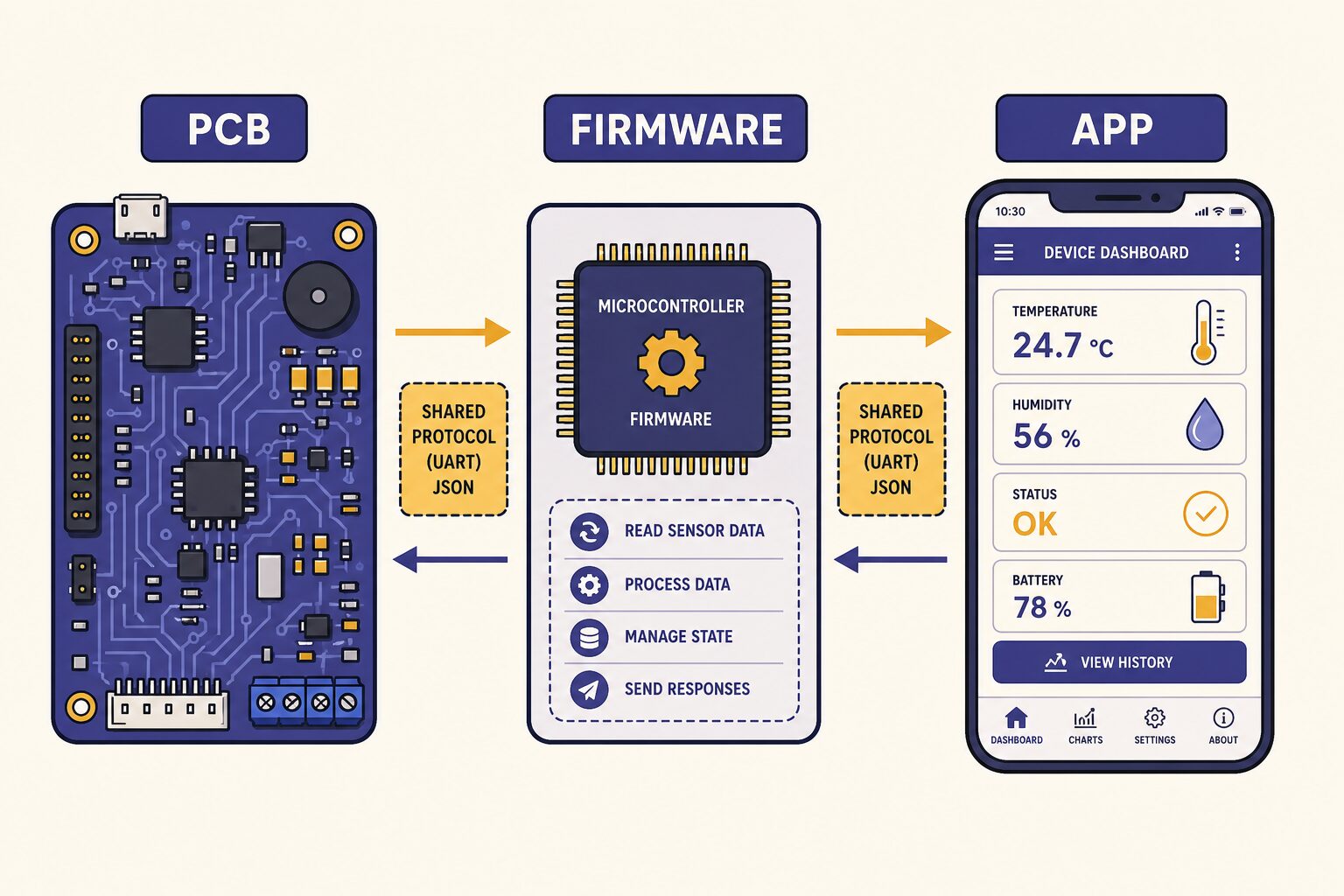
Revan Technology addressed this under the new service axis Mobile App + End-to-End Mobile + Electronics Board. An ESP32-family embedded stack, a Flutter cross-platform UI and the BLE protocol between them lived in one design document.
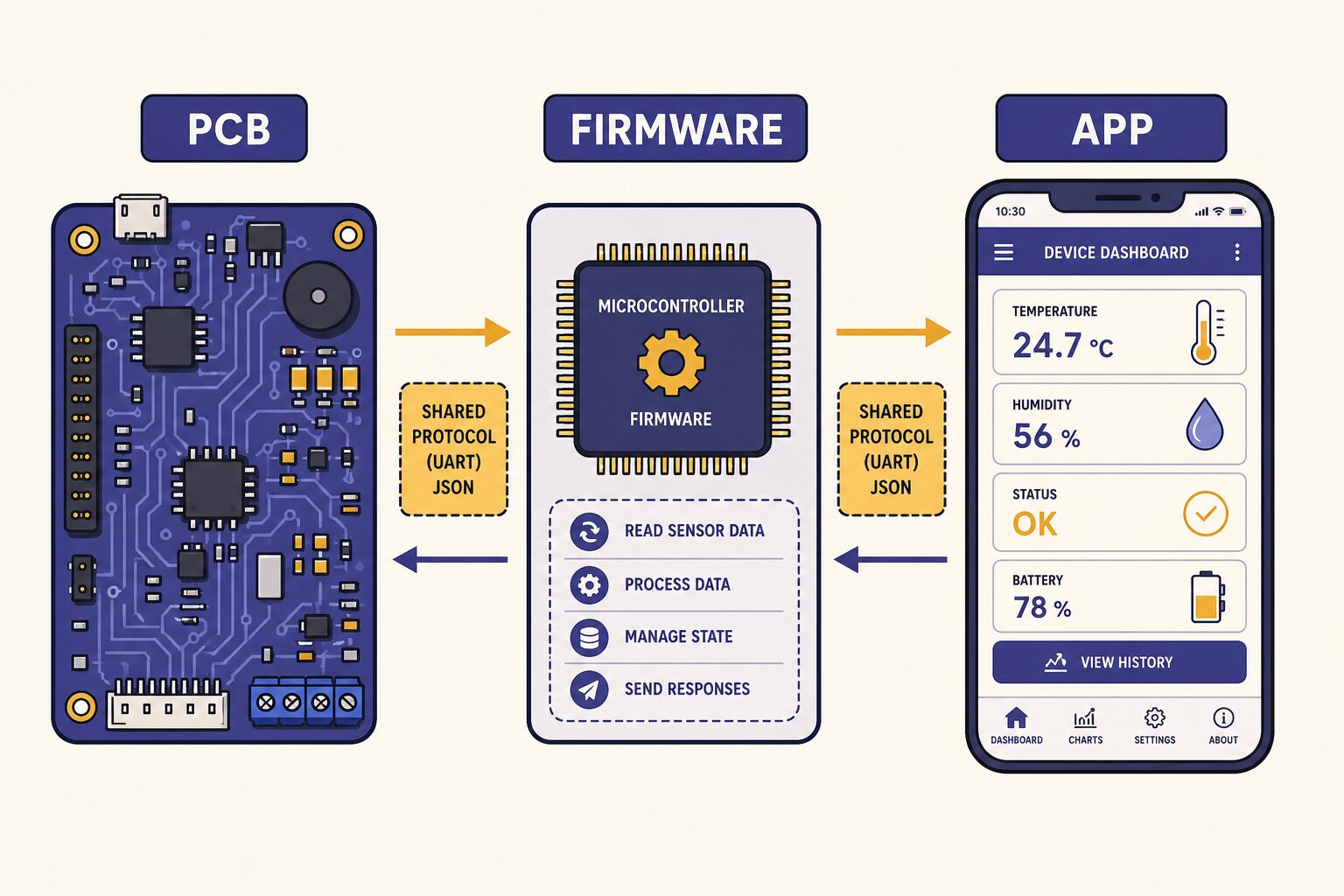
We first froze the device profile (services/characteristics, command frame, status bitmap). PCB power/antenna/load constraints then ran in parallel with firmware tasks; mobile consumed the same protocol SDK for the UI. Version fields (firmware major.minor, protocol revision, app build) are checked on every connect; mismatches show a clear user message.
The goal was not a demo video, but a maintainable end-to-end product line the customer can sell under their own brand.
An ESP32 / ESP32-C3 class SoC was selected for RF and GPIO needs. The PCB accounts for antenna clearance, supply noise filtering, programming/production test points and industrial connectors. DFM notes (panelisation, fiducials, test pads) were embedded in the first revision so “working sample” and “manufacturable board” stay close.
Firmware exposes fixed-UUID services on NimBLE (or equivalent). Command packets carry sequence, opcode, payload and a short CRC/checksum; responses return status and error codes. Protocol revision is published on a dedicated characteristic. Watchdog, disconnect policy and safe state (e.g. relays off) are part of product safety. For OTA, a dual app slot or factory partition was planned; v1 paired cable update with signed-package preparation.
The Flutter app layers BLE scan/connect, protocol codec and UI state machines. A shared codec file (or generated constants) feeds from one source. A version gate runs at launch and on connect; low protocol revisions trigger an update path. Optional technical event summaries aid field diagnosis without collecting personal data.
The customer moved from split supply to a single-owner end-to-end product development with Flutter and ESP32 line.
This project shows how Revan Technology combines electronics board, embedded software and mobile app services on one product axis. If you need a similar end-to-end product, we can scope it together.
For customer privacy, company and product names are not shared in this article. Images are representative and used to illustrate the functional structure.
🔗 Get in touch with us:
Phone/WhatsApp: +41 76 212 8248
📧 E-Mail: info@revantechnology.ch
For detailed information about our services in electronics development & PCB design:
Revan Technology – Your partner for professional electronics and PCB development