 Emre Ceylan
Fail-safe industrial OTA with dual-bank bootloaders that never brick a device is the core engineering decision that prevents the costliest failure mode on distributed industrial nodes. Classic over-the-air updates that erase a single application region in place can leave a unit without a runnable image after power loss or a dropped link—forcing truck rolls or factory reflash.
At Revan Engineering, we standardize on dual-bank flash plus a fail-safe bootloader for software development and embedded deployments, whether updates arrive over cellular, BLE, or Ethernet. The analysis below is drawn from field brick cases and our mitigation steps; no customer or product names are included.

What dual-bank flash and a fail-safe bootloader are
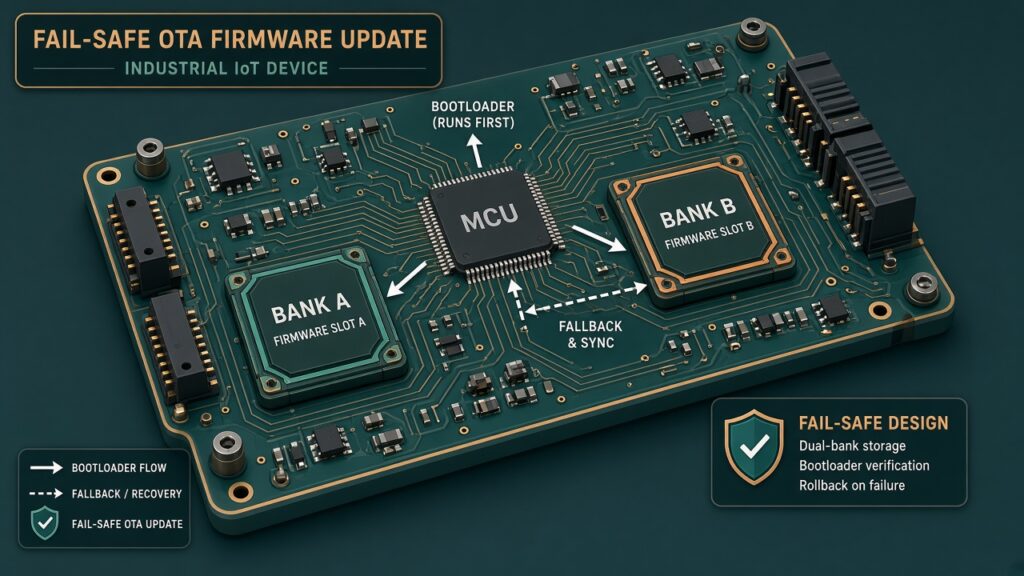
Dual-bank flash reserves two full application slots (Bank A / Bank B) in microcontroller or external NOR flash. The active bank runs production firmware while updates write only to the inactive bank; after verification, the bootloader performs a bank swap. A fail-safe bootloader checks signature/CRC on every reset, rejects a corrupted bank, and boots the last known-good image.
Single-bank OTA often follows “erase old, write new.” A watchdog trip or mains glitch in that window creates a permanent brick. With dual-bank design, brick risk drops sharply except for design flaws—swap flags in the wrong place, missing rollback paths, or unsafe metadata updates.
Problem context
Measurement modules, energy meters, and field gateways sit on crane tops, wellheads, or dusty panels. Remote firmware update is mandatory, yet cellular coverage fluctuates, 24 V supplies glitch, and opening an enclosure can disconnect UART with ESD.
The customer expectation is clear: after a failed update, the device must keep running on the previous release, preserving parameters and calibration. That guarantee is impossible on one flash region. One bricked unit can cost weeks of shipment, dismantling, and factory reflash; the same mistake across hundreds of nodes in an IoT fleet is painfully realistic.
Technical analysis
Memory map: The bootloader (typically 32–128 KB) stays in a protected sector. Banks A and B are equal or “active + staging” sized; metadata (active bank flag, version, image hash) lives in a dedicated sector updated atomically for the final swap step.
Update state machine: (1) Download chunks into staging; (2) per-chunk CRC; (3) full-image verify with RSA/ECDSA or shared secret; (4) set “pending swap”; (5) after warm/cold reset the bootloader test-boots the new bank—the application “commits” on first successful run, otherwise automatic rollback.
Power loss: A half-written staging bank is discarded; the active bank is untouched. Critical bug pattern: updating metadata and staging together—staging must complete before any swap flag.
Size and MCU choice: External SPI flash keeps dual-bank affordable; on-chip flash needs headroom for two images plus margin. Keep the bootloader small; split low-level download/verify from TLS-heavy stacks.
Downgrade protection: Anti-rollback counters or minimum-version metadata bind to signed package versions; otherwise an old vulnerable image can be installed deliberately.
Factory and service mode: UART/USB recovery, a strap pin, or an optional factory “golden” image remain the last resort when remote recovery fails—the main line is still dual-bank.
Field scenarios
- Partial GSM download: Link dropped at 94% of 1.2 MB; incomplete staging rejected, measurement continued on the old bank.
- Panel reset loop: Contactor opened mid-update before swap; old bank booted—customer feared “death,” but silent rollback had worked.
- Wrong device package: Manifest device ID mismatch; bootloader refused write even if signature verified.
- Watchdog during upload: Reset in a long verify loop; half staging ignored, but a buggy swap flag was caught in test—fixed with mirrored metadata sectors.
- Small BLE MTU: Chunk reorder broke the hash; UI showed retry without touching the active bank.
Solution approaches
Our process starts with a risk matrix: update channel, signature policy, flash size, and field access time. The software development team defines a contract for bootloader APIs (enter update, report status, commit); hardware documents brownout detect and minimum supply during writes.
Preferred pattern: download–verify–swap—the active bank is never erased. Remote logs (version, bank, error code) explain most “brick” tickets as rollback plus misconfiguration. CI must produce signed artifacts; lab tests always include power-cut simulation before fleet push.
Benefits
Fail-safe industrial OTA with dual-bank bootloaders that never brick a device becomes measurable: guaranteed return to the previous release on failure, fleet-wide updates with minimal truck rolls, and faster security or compliance patches. Typical savings: days of field cost per avoided brick and support tickets reduced to a single rollback log line.
Sector observation / experience
In IoT programs OTA is often deferred to “phase two”; the memory map no longer fits and customers ship single-bank. The dual-bank decision belongs in spin 1: test points, recovery pins, and flash capacity on the BOM.
Bootloader updates carry separate risk—when possible protect the bootloader with A/B or write-protect. Field staff must learn that “update done but old version showing” often means successful rollback; otherwise they trigger needless interventions.
Conclusion
Fail-safe industrial OTA: dual-bank bootloaders that never brick a device make remote maintenance viable on distributed hardware. Staging bank, signed verification, atomic swap, and automatic rollback keep runnable firmware even under power and link uncertainty. Lock the memory map at project start, ship a signed pipeline with manufacturing, and expose a logged state machine in the field—that is the foundation of fleet management.
🔗 Get in touch with us:
Phone/WhatsApp: +41 76 212 8248
📧 E-Mail: info@revantechnology.ch
For detailed information about our services in electronics development & PCB design:
Revan Technology – Your partner for professional electronics and PCB development