 Emre Ceylan
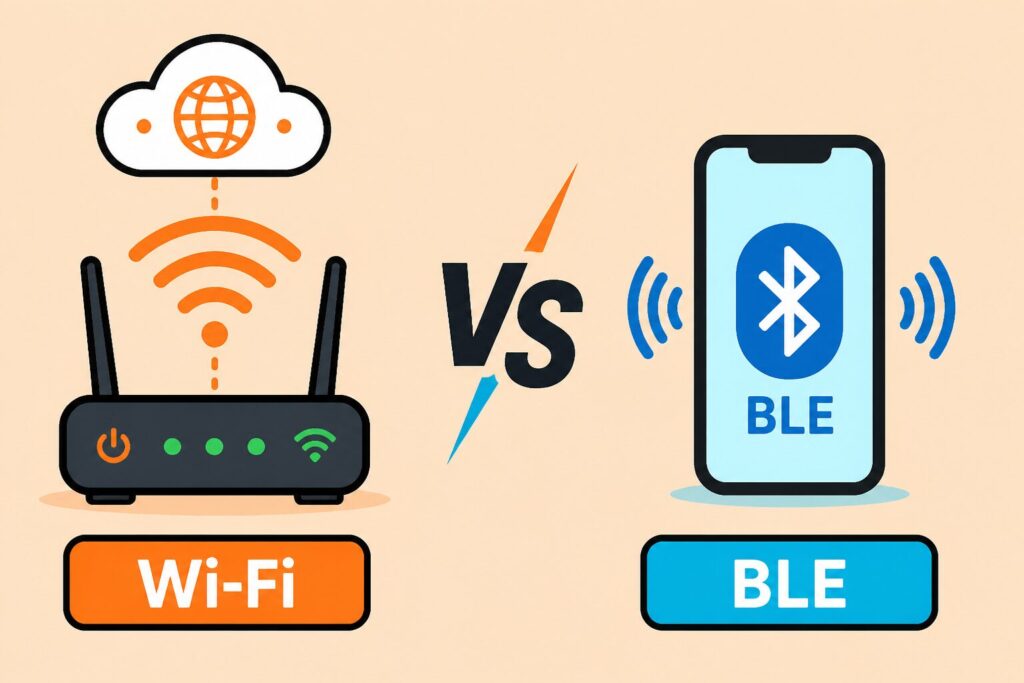
The Wi-Fi vs BLE field product debate often starts with “which is more modern?” — the right question is the use case. A gate relay, handheld pairing session, warehouse sensor or machine-HMI bridge will not share one RF answer. This article summarises the decision criteria Revan Technology uses on industrial and embedded projects: range, power, pairing, provisioning, latency and cost.
The goal is not to crush one technology with another, but to turn product requirements into measurable questions.
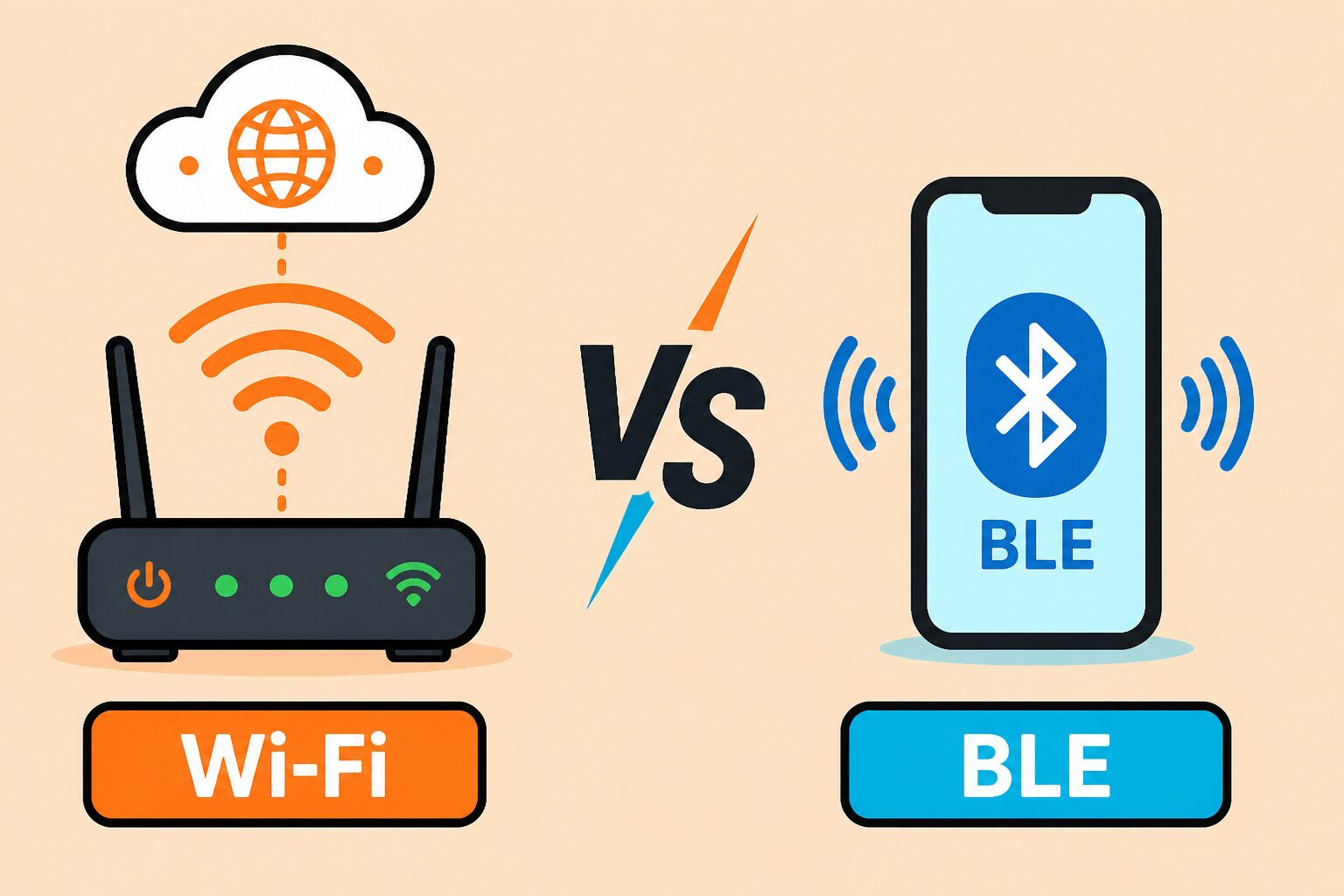
Wi-Fi vs BLE field product criteria
The sections below frame a wi-fi vs ble field product decision.
Range and environment
Wi-Fi typically covers tens to about a hundred metres via an access point; walls, metal panels and industrial noise shrink real range. BLE is strong in the phone–device near field (usually a few to tens of metres); mesh or a gateway can extend it but adds architectural complexity.
For a relay board inside a metal cabinet with the operator standing at a barrier panel, BLE is often enough. If the same board must reach a plant-wide cloud, you need Wi-Fi (or cellular). “Is range enough?” must be asked together with antenna type and enclosure material.
Power consumption
On battery or energy-harvest nodes, BLE usually offers lower average power; advertising / connection intervals can stretch sleep time. Wi-Fi association and TCP/TLS sessions drain batteries quickly on short measurement periods.
On mains- or 12 V panel-powered always-on products, power may be secondary; heat, regulator size and EMC matter more. If battery life is a KPI, BLE has a strong case; if you need an always-online dashboard, consider Wi-Fi or a hybrid (local BLE + Wi-Fi gateway).
Pairing and user experience
BLE’s strength is connecting straight from an app via the phone’s built-in scanner / GATT stack. Users see the device without knowing an SSID/password; PIN or bonding adds authorisation. Wi-Fi products need soft-AP, WAC, Bluetooth provisioning or QR to pass network credentials — first setup grows longer.
For a field technician, “walk up, connect, configure” is natural on BLE. Permanent remote monitoring does not complete without Wi-Fi/GSM. If the product wants both worlds, draw a clear line: local BLE commands, remote Wi-Fi/GSM telemetry.
Provisioning and security
Wi-Fi provisioning carries operational risks: wrong SSID, enterprise WPA2-Enterprise, guest networks and certificate renewal. On BLE you need bonding, LE Secure Connections and an app-layer PIN/session; short range does not make open advertising safe.
Common ground: the RF layer alone is not product security. Command signing, session lifetime, rate limits and disconnect safe-state must be designed for both technologies. In Revan Technology projects, protocol security is kept as a checklist separate from the transport layer.
Latency and determinism
For local relay pulse or short loops similar to an assist command, connected BLE latency is usually low enough; still measure connection interval and Notify delay. Cloud round-trips over Wi-Fi can push field latency into seconds — local safety loops must not live in the cloud.
For machine-safety stops, a wired safety loop is essential; BLE/Wi-Fi are only for auxiliary command and status. If that split is missing from the spec, “wireless e-stop” becomes a dangerous misunderstanding.
Cost and productisation
At chip level, ESP32-class SoCs can offer both RFs; real cost sits in antenna, certification (FCC/CE/RED), mobile app maintenance and field support. Choosing Wi-Fi alone also brings cloud backend and user-account operations. Choosing BLE alone may add gateway hardware when long range appears.
Compare total cost of ownership, not only BOM: provisioning calls, password changes, OTA infrastructure and return rate. In a Wi-Fi vs BLE which fits a field product decision, the “cheap module” is often the expensive choice.
Decision summary
- Near-field command, phone UX, low power → BLE
- Plant-wide IP, cloud dashboard, continuous telemetry → Wi-Fi (or cellular)
- Both → local BLE + remote Wi-Fi/GSM hybrid, with written protocol boundaries
Results
The right RF for a field product is chosen at the intersection of range, power, pairing, provisioning, latency and cost — not by marketing slogans. Revan Technology locks this matrix to product requirements on electronics-board and mobile-app projects to cut “change the protocol later” cost. Drawing UI or spinning PCB before the decision is settled means pulling revision forward.
🔗 Get in touch with us:
Phone/WhatsApp: +41 76 212 8248
📧 E-Mail: info@revantechnology.ch
For detailed information about our services in electronics development & PCB design:
Revan Technology – Your partner for professional electronics and PCB development